Monday, August 2, 2010

Kohav Nolad in Hof Ashkelon--a delightful evening!

On July 27th, I (Dina Tanners) was treated to a wonderful evening at the Hof Ashkelon regional center auditorium. 

Before that night, 70 children (ages 7 to 12  from many communities in Hof Ashkelon auditioned for the Israeli version of a American Idol, Kohav Nolad  (A Star Is Born) כוכב נולד .  Ten children in 8 groups  (two duets) from ages 8 to 12 made the finals. They were from Nitzan, Kibbutz Karmia, and Moshav Talme Yafa.  Many were 9 1/2.  A small group of "supporters" who danced in the background also accompanied several of the groups.  They were children and teens from the local area. 

It had been the custom in one of the communities in Gaza for the children to have an annual Kohav Nolad competition.  When many of them moved to temporary housing in Nitzan Bet, they continued the tradition.  This year, the regional council of Hof Ashkelon decided to make it a regional competition, and with 70 auditioning, it was quite successful.  The talent was amazing!

The first to perform were twin sisters, age 9 and a half from Kibbutz Karmia.
Twin Sisters from Kibbutz Karmia
They were very very cute and fun to watch.  I was surprised to realize that they were lip sinc-ing and not singing, but I was told for this age group, it probably was the best as they were less nervous.


Before each performance, there was a short video, interviewing the participants.  They introduced themselves and told what they loved to do in addition to singing.  You can see the screen in the backgrounds.

Both the 2nd and 3rd peformers had husky voices, stronger than I would have expected for anyone that age.  They both have tremendous potential with training.

Second performer, also 9ish, from Nitzan

The theme for the song contest was songs from the army bands, so each performer had to choose an appropriate song.  There are many amazing songs that the military bands have performed.  Such groups have come to the US many times. 


The fourth performer was Shir, an 11-year-old from Nitzan.  When she began to sing, I was blown away by the maturity of her voice.   It was amazing.
Shir

The girls that danced in the background had different costumes for each performance.  The change below must have been the third set of costumes and more were to come.
Another 9 year old
End of Song--with Entourage
Pair from Nitzan
I was wondering if any boys made it to the finals when this duet came on stage.  They too were very cute, and the boy especially had a strong voice.  Revital said that he originally was quite nervous and not sure of performing but got stronger and more confident as he continued to practice.


When the seventh performer came on stage and began to sing, this twelve-year-old also blew me away.  I had been named one of the 6 judges (as an honor to me as American chair of the TIPS partnership), and I knew I would have a tough time deciding between her (Valerie) and Shir for first place. 
She too had a strong voice and also a great stage presence.

We were also asked to choose our "favorite" performer...and not base the decision on singing quality but just on gut instinct, cuteness, stage presence, whatever.  The last performer, Shon, the yougest of the group at age 8, was the winner.  He was adorable.

Shon

The audience was animated, and groups came with signs supporting their favorites.

Supporters of Liav and friend form Nitzan


After the individual performances, as the votes of the 6 judges were tabulated, the 10 performers sang together.


The award staff is at work below.  The woman on the left is from Hof Ashkelon and was on the national TV show Kohav Nolad several years ago.  She is blind.  Dina is 3rd from the left.
Handing Out Gifts to the Finalists
The Winner--Valerie from Moshav Talmeh Yaffeh
The top three places were awarded to:
First Place:      Valerie from Talmeh Yaffeh  ולרי דבורקין- תלמי יפה
Second Place:  Shir from Nitzan     שירי יפרח- ניצן
Third Place:     Sapir from Talmeh Yaffeh    ספיר קסר-- תלמי יפה

Congratuations to all the participants.  They were wonderful!!

Schwartz family celebrates KM's 60th anniversary & special Bar Mitzvah

Today was not our first visit to Kiryat Malachi during this trip. Last week we had the pleasure to attend the 60th Anniversary celebration for the city. It was exciting to see a dozen or more members of the Knesset in attendance along with the city’s Mayor, Deputy Mayor and Council members. I had the pleasure of sitting next to a gentleman who had moved to Kiryat Malachi at it’s founding. Periodically during the ceremony he would tap me on the shoulder to tell me one interesting fact or another about the early days of Kiryat Malachi. He told me how people lived in tents, the limited kinds of food they ate, and much more. He was really a very interesting source of information about the community that I had not heard previously.

The celebration was filled with speakers, a take off on "The Amazing Race", as well as song and dance. What was so gratifying was how much of a role our partnership played in the celebration. Among the entertainment were the dancers that performed at our local Yom Ha’atzmaut celebration this past April. An example of the role our Federation played was to fund the creation of "Art City" which brought together what had been separate clubs involved in song, dance and music. Our initiative brought these groups (along with dramatic arts groups) together under the auspices of one coordinated performance troupe.

During the celebration, it was fun to see a "rock band" made up of teenagers, performing with young singers and fabulous dancers, which together created an amazing spectacle for all in attendance. During the performance, I asked our Israeli staff person if I had a right to feel the kind of pride I was feeling and his response was "absolutely". It was truly a one of a kind experience that I don’t think I will ever forget.

After spending our final Shabbat (for this trip) in Jerusalem, which is always a highlight of travel to Israel, we began to pack our bags for our move to Kiryat Malachi. Upon our arrival we receive a friendly welcome by others living in the same complex. We are now looking forward to our time in Kiryat Malachi as we prepare to spend some time volunteering. Our first assignment will be at one of the local schools where we, including our children, will have an opportunity to help local youth develop their English skills. We also hope to work with some after-school programs that will enable us to interact with some of the families who live in this community. I anticipate that this opportunity will certainly add an important element to our experience here in Israel and for my children, especially my eldest, to understanding in very real terms what it means to be part of a Jewish people worldwide.


Jacob, son of Adam (president and CEO of the Jewish Federation of Greater Phoenix) and Stacey Schwartz, became a Bar Mitzvah at Yad Mordechai. This kibbutz in our TIPS Partnership Hof Ashkelon region was the site of an important battle during Israel’s War of Independence. Jacob conducted a Monday morning service, chanted the Torah portion and led a discussion on the d’var Torah. He gave his interpretation of the Torah reading, first in Hebrew and then in English, to the surprise and delight of everyone, especially the Israelis. Yair Farjun, chair of the Hof Ashkelon regional council, presented the celebrant with a copy of Pirke Avot, and a group of Ethiopian women prepared lunch afterward. These women had visited Phoenix and Tucson as part of the TIPS Women’s Ethnic Cooking Project last fall, when Jacob struck up a friendship with them, leading them to offer to cater his simcha. Also, thanks to modern technology, the celebrants were able to Skype the entire service back to family members in the United States

Shabbat in Kiryat Malachi, Schwartz Family, June 2010

June 28, 2010 at 12:57 PM


I have spent a fair amount of time in Kiryat Malachi during past missions/trips to Israel. But I have never spent a full Shabbat in this city that makes up part of our TIPS partnership.

As this past week ended and we prepared to celebrate Shabbat here, I was excited to see how it compared to my experiences in other communities in which I have celebrated Shabbat.

As Friday moved along, we could definitely sense a change in the community. Stores were closing early. There was less and less traffic on the streets. A calm was beginning to settle in that would accompany us through our celebration of Shabbat.

As the time for Shabbat began, we lit candles in our apartment and headed out for Shabbat dinner at the home of the Attal family. I have known Dvora Attal for many years as she plays a critical role in our partnership on behalf of the Kiryat Malachi municipality. And I had celebrated Shabbat dinner with her family once before many years ago. I was looking forward to having an enjoyable evening celebrating the start of Shabbat. And a wonderful evening it was. The food was outstanding. The company was even better. My wife and children loved being with Dvora’s family who could not have been more hospitable. They helped get our Shabbat off to a wonderful start. My wife and I had a very nice visit with our children as we walked home on the quiet streets of the city.

For lunch Saturday, we headed out on a lovely walk to the Peretz family home. This was not a family that I had spent time with, but I knew that they had been very involved with the partnership. I also knew that the art contest that we have run through the partnership was dedicated, in part, to their son who had passed away from cystic fibrosis. Once again, we had a delicious lunch. And, again, the company was even more wonderful. We talked about a whole range of things in Hebrew and in English. And our hosts could not have been more gracious to our children. They were able to see olive trees, fig trees, pomegranate trees and more…all in the yard of an urban Israeli home…They were amazed!

We had a lovely walk home, again on quite (but hot and sunny) streets of Kiryat Malachi. We had time for a quick nap, at least our two year old and me and my wife. And then it was off to another home for seudah shlishit, the third Shabbat meal. This time it was to the home of the Azriel family. Their daughter Shir is going to be leaving this coming week to work in the day camp at the Barness Family JCC. And, not to repeat myself, we had a terrific meal and fantastic company. We could not believe that it was after 11 p.m. when we finally packed the kids up for our walk home.

In thinking about this amazing, wonderful, uplifting day, a number of things really struck home with me. The first was how hospitable the families were towards me, my wife and our children. This was especially impressive given the fact that none of them had young children at home any longer.

The second thing that struck me had to do with the type of food we ate this Shabbat. At every meal, we enjoyed traditional Sephardic dishes that my children had never seen or heard of before. It was wonderful to be able to expose them to other aspects of Jewish life.

The third, and in fact the most important, was the connection that we have through our partnership and through being Jews. It did not matter whether or not we had known each other. And the respective levels of observance were unimportant. We were celebrating Shabbat together as Jewish people who shared that bond.

I have spent many Shabbat in Israel. But I am hard pressed to find any that were more meaningful or enjoyable. And my family and I are deeply grateful to the families in Kiryat Malachi who made it such a special day (and this past week) for us. We are looking forward to our last few days this coming week with a mix of happiness and regret. We have experienced so many incredible things and have made so many wonderful friends. And we look forward to building on these experiences in the future.


I wish you all a Shavua Tov and a wonderful week ahead.

Adam Schwartz, President and CEO, Jewish Federation of Greater Phoenix

Saturday, July 31, 2010

Shorts from Israel, July 30, 2010, on subjects big and small


1)  The city of Kiryat Malachi continues to upgrade the way the city looks.  We see street sweepers at least twice a week go by our apartment. 
The roundabout at the intersection of Ben Gurion and Jabotinsky really looks lovely, with a mature olive tree in the center and a bubbling fountain too. 


There are signs of construction in town:


2)  We are amazed at the building of new roads and improving old ones.  We found out that one reason there is a huge push to improve roads in the south of the country is that the army will be moving its basic training location from the center of the country and some parts further north to the south, in the greater Beersheva area.

Expanding road outsdide of Beersheva
 Most main roads have dividers (see left of photo above) between the two different flows of traffic for safety.  To reduce congestions, there are new and improved roads going on the outskirts of Beersheva The new highway intersections/cloverleafs are quite spectactular in that area.  We also noticed a number of speed traps with police using laser guns to catch speeders.


There is a new train line that will go to Beersheva and a lot of improvement is going into the roads there.  Highway 6, the toll road, last year opened its branch from the Ashdod/Ashkelon exit southward.  There is no toll on that part of the highway as the government built it and not private industry as the volume might not have been big enough for profit, but it was needed because of the army shift and to encourage more people to move into that area.

3)  This past week, Israelis were shocked by the deaths of 4 pilots and 3 other air force officers in helicopter training exercise in Romania. http://www.ynetnews.com/articles/0,7340,L-3927326,00.html  The helicopter is huge, and could carry 50, but they only allow up to 20 in one after 50+ were killed years ago in a training exercise.  After the names of the dead were announced, the daily national newspaper Maariv dedicated one page for each of those who died in the crash.

4)  Some of the people who left Gush Katif and moved into temporary housing 5 years ago north of Ashkelon are now moving into their permanent homes.  We visited with the librarian at Nitzan, Ayala. 

Ayala on right at work
Her family should be able to move into its new home before the holidays. 

Ayala in her new kitchen
Her son Itai was a counselor in Seattle a few years ago.  We met another man, a doctor, who had rented a home in Gaza when he lived there.  As a result, he was not given a subsidy since he had not owned a home.  Others like him are in limbo.  They are trying to negotiate with the government to get something so that they can get out of the temporary housing they have been in for 5 years.

5)  Here are a few signs that we would not see in our communities in the US:

No entrance on holidays and Shabbat

                           Beware of Camel Crossing near Mamshit--also visual signs with picture of camel    
Street signs in 3 languages, Hebrew, Arabic, and English
The letter "Q" not followed by a "U"
This is one of the few signs in the area pointing toward Kiryat Malachi.  It is about 7 miles from town.

6)  Friday night we were invited to friends for dinner and we offered to bring a bottle of wine.  Suddenly at 3 p.m. I remembered to buy it and rushed to the supermarket across the street.  I was afraid that it had already closed, but I was assured by the guard on duty that the store would stay open until 3:30 p.m.  Most of the other businesses in town usually close before that on Friday afternoon and stay closed until Saturday night or Sunday morning, the start of the week.   Here is a picture I took in front of our apartment at 5:30 Friday afternoon.  The usually busy streets were empty, as you can see.


7)  Plastic  and glass bottles are the main items recycled by residents in towns.  Large plastic  bottles  (a liter or more) are collected in huge bins, while smaller plastic and glass bottles can be returned to supermarkets for 30 agorot each (approximately 8 cents US).

8)  One day I went to buy 1% milk.  When Howard took a drink, he wondered if something were wrong with the milk.  I looked carefully at the container and realized that it was a milk "drink" with sugar added....and yes, it was 1%--lower fat but added sugar.  Phoey!
                             
9)  Bread is the staple of life, so for many people it is hard to throw away.  In the US we often freeze it for stuffing or make bread crumbs from it.  Many Israelis don't like to throw it away either, so they often put it next to the community garbage can or in other conspicuous places.  Here are two of my favorite ones:

Bread on a fence post
      
A crow pecking at a bag of bread on top of the plastic bottle recycling cage

10)  Driving in Jerusalem is an experience that we don't want to do very often.  Even Dalia Burgana has told me that when she has to go to Jerusalem, she drives just inside the city and then takes a cab to where she has to go.  We drove in Jerusalem last Thursday to get to Har (Mount) Herzl and then to visit some cousins in Katamon (now called Gonen).  It was definitely harrowing.  Twice Howard made u turns where they were not allowed.  If he hadn't we might not have been able to turn around for a long time.  There is a lot of traffic, many hills, huge intersections, new one-way streets, a lack of numbers of buildings, often a lack of street signs, and crazy drivers.  What more can I add!

Youth Council in Kiryat Malachi--On the Move

On July 26th, I met with Moriah and a member of the Kiryat Malachi Youth Council, Lital, in Moriah's apartment. Moriah lives in the Weitzman neighborhood, very close to Dalia.  This year the Youth Council was restructured, under the leadership of Moriah Ben-David, who was appointed the Youth Director (ages 12 to 18) for the city of Kiryat Malachi in late August, 2009.

I talked almost exclusively with Lital as my main purpose was to hear from a member of the Youth Council about the group itself. All but two of the YC members this year are girls. They hope to add more guys in the fall (to replace the graduates, like Lital.)

Lital just graduated from high school. She has been active in Migdalo, a program mainly for teens in the poorer neighborhoods in town so that teens have some place to go after school and in summers.  it is directed by Yaffa Golan. (Yaffa's son Yarden was a counselor in Seattle the summer of 2009). Migdalo, a Better Together program, is one of two teen groups in KM that has its own steering committee/leadership group, and Lital has been a member of that leadership group. This fall, they appointed her as the representative from the group to the KM Youth Council.

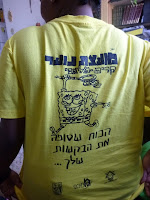
Lital was wearing a yellow KM Youth Council shirt so I asked her about it. She said that the group felt it was important to have a YC shirt so that teens around town would recognize who they were, to "brand" them. Three or four in the group worked together on the shirt project. They made a design, checked out places that print shirts, found a good, cheap price and had 50 made, the minimum number. They distributed a bit more than 20 this year and will have more for new members that join in the next few years. Each shirt had the logo of KM, the MATNAS, and the Jewish Agency. (At that time they did not have the TIPS logo, but they do have it now and will use it from now on. Moriah has taught them it is important to recognize those who support the group.)

Lital said that it took a while for the new youth council members to learn to function as a group. They didn't really know each other in depth....in some cases they knew others enough to say "hi" but that was about it. The city gave them the "first building" in town, Beit Harishonim, to use as their center. It was messy inside, so they spent a lot of time cleaning it up, painting it, putting up pictures, etc.

The group meets regularly from 6 to 8 p.m. on Sunday evenings and sometimes on Wednesdays too when needed. (If they cannot attend meetings or if they will be late, they are required to contact Moriah in advance.)

At the beginning, they had activities to learn about each other and more about themselves. Through these activities and planning of events (includiing cleaning of Beit Harishonim and taking responsibility for different parts of the clean up), Lital said she learned a lot about herself. She learned that she could "give" more than she thought she was able to. Also, she learned in depth what "responsibility" meant and how important follow through was. She learned that if she volunteered for something, she had to follow through because others counted on her, so she could not say later that she could not do it.

The first big event that they planned was the "opening ceremony" of the youth council where the YC members were officially sworn in. It was in the MATNAS auditorium, and the place was full. The YC members felt it was important to have a big public event so that people would know who they were and what they stood for. One girl named Avniela who never had spoken up much, volunteered to be the master of ceremonies. (Moriah was surprised to see her volunteer, but let the group take control of the program.) It turned out that Avniela was a great MC. BTW, she represents the "teens at risk" in the Youth Council. Less than 6 months before the event, this young woman would never have volunteered to do such a thing.

One memorable training program that 15 out of 20 of the YC members attended was a workshop on leadership for members of Youth Councils in all of the southern region of Israel, around Purim. They got permission from schools to be absent. The program was from noon to 9 p.m. They attended a number of workshops on being leaders. For example, in schools, they are not taught to speak in front of groups. At one workshop, they learned and practiced how to do so, a skill that Lital feels has really helped them. A side effect of the workshop day was that they met and interacted with youth leaders from other parts of Israel.

As a result of the meeting, several KM YC members wanted to get together with the YC in Ashkelon and share ideas. So far they have not succeeded, but they continue to try. (They are learning that planning takes a lot of work and not every suggestion that they work on comes to fruition.)

They divided into sub-committees for a while, but then found out that many wanted to work on several different sub-committees, so they have dropped that idea for the time being.

They were involved in the KM 60th anniversary celebration and helped with different parts. One thing that they did with other youth was to work with the local deaf group and learned to sign the song "Yachad Lev v'lev" and sang and signed with them at the 60th anniversary celebration.

For several months they have been planning a big event that will take place this coming Tuesday afternoon, August 3. (Unfortunately, we fly out of Israel that morning.) The event is to mark 1500 days that Gilad Shalit has been a captive. At 5 p.m. participants will gather near the soccer field and then march together with signs (made by the youth) to the park near the MATNAS, where a program will follow, totally planned by the youth. They had hoped to get a member of Gilad's family, and he did agree to come at first, but then when other bigger communities started to plan a similar event, he had to turn them down. However, another representative of the national group to free Gilad will come and speak in KM. Other speakers include the mayor, the head of the MATNAS, and a member of the YC; the KM chief rabbi will give a blessing for Gilad; and Limor will sing as will a choir from AMIT high School. (I heard her last week when she tried out for Kohav Nolad...she has a lovely voice.) They will have 150 balloons that will be released in the park, symbolic of 1500 days Shalit has been a prisoner.


About 7 from the YC also went on a bus rented by the city to a Gilad Shalit event as his parents were walking to Jerusalem from the Galil. The mayor had invited them to represent the city youth. They had to be ready to leave at 6 a.m., not a common time in the summer for teens here. In advance, the YC made signs for the group to take and had extras for some other people on the bus.

As a follow up activity to the big event on August 3, they plan to go to different youth groups in town and hold small discussions called "Cafe Dilemma." They will talk about the "costs" of freeing Gilad, and of not freeing him. Members of the youth group will help lead the discussions.

In advance, the group did big cloth posters and put them up in town.

 The flyer (above) is being passed out now throughout town.

One more event is in the planning stage but still the early stages. The group wants to do something on the problems of drugs and alcohol, or on responsible driving. At this point, the have not yet decided on which area to focus. Once they do, they know they want an event where they can bring in a teen group that sing songs focusing on these issues to get the attention of teens in town. Then they plan to do follow up activities, mainly through the youth groups in town to have educational discussions on the focus problems.

The group also has a Facebook page at http://www.facebook.com/?ref=home#!/profile.php?id=100001024635531 for ‏נוער קריית מלאכי

I also asked Lital what the Youth Council meant to her personally. She said that although she only had one year to be involved since its rebirth, it really helped her a lot. As I mentioned earlier, she really learned what responsibility meant in depth and the importance of follow through. She also learned how to deal with many different kinds of people. Through the YC events and programs, she was pushed out of her comfort zone and succeeded, growing and maturing. She is religious, so will not go to the army but will do "national service." She originally had planned to work in a hospital. But since her experience on the Youth Council, she decided to work with teens at risk in Petach Tikva. She feels that if she is capable, and should take responsibility to do something more challenging.

Now I have finished my "reporting," and want to add a personal note.

If Lital is representative of the teens on the Youth Council, I think that TIPS can be proud of what the group has succeeded in doing. It has taken them longer to do some activities than we had expected, but they are working as a group, learning and growing from the experience, and leading the teens.

Sports and Structure turn potential delinquents into Leaders in Kiryat Malachi

In mid-July, at Dvora Attal's suggestion, I met with Elad, the head staff person at Moadon Shahar, where the Poel Tel Aviv program for 7th and 8th graders is centered.


Elad is the head staff person (1/3 time officially but works much more) for this program.   He moved to Kiryat Malachi after getting married.  Moadon Shahar is supported by Better Together and 2 other organizations. It was begun 2 years ago to reduce vandalism in town. During the school year, the program is run on Tuesdays and Thursdays from 4 to 7 p.m. in the AMIT school, and includes 35 boys and girls in the Herzl, Weitzman, and Kibbutz Galiot neighborhoods. Over 75% are Ethiopian-Israeli. They do meet in the summer too.

The program is built around 3 factors, each one lasting an hour:
1. Studies: For one hour the youth sit in groups of 5 together with a “teacher” who helps them with homework. If they don’t have homework, the “teacher” supplies educational activities to improve their study habits and basic skills. The teachers are volunteers, some through a special army program, some in National Service, and a few local people who want to help.

2. Planned Activities: The activities revolve around a month theme. For example, one might be the “value of giving.” The youth plan activities and carry them out. Activities have included visiting people in the hospital, helping younger children with homework, etc.

3. Sports: This is the HaPoel Tel Aviv component supported by TIPS. The youth hear lectures about qualities that make a good team player and practice them as they play together. They learn good behavior on court, problems some of the pros have had with drugs and alcohol and how that hurt their careers. They go to Tel Aviv to the Wolfson Center (where the HaPoel Tel Aviv professional soccer team plays) twice a year to see games (around Hanukkah and at the end of the year).

Elad said that the HaPoel Tel Aviv program pull the youth into the entire program in the first place. Without this incentive, many would not have come. The entire program is very structured, and Elad works with the Poel Tel Aviv coordinator to make a master plan for the year. He also meets with Moriah (and sometimes Dvora) to advise her of what is happening in his program and also to coordinate with other “clubs” in town.

I asked Elad how the 35 youth were chosen. He said that this program is, in part, a continuation of the Tzeva program (Tzi-irim Bonim Atid—youth build a future), which is also connected to Better Together is the poorer neighborhoods in town listed above.

He said that at the beginning of the year, he meets with Meirav, the coordinator fo the Tzeva program and picks out a number of kids in that program who would benefit from continuing in the Moadon Shahar. He also works with the counselors at the schools to see who are the most needy and are not already in another support program.

The program has a very strong structure with a clear list of behavior rules. The rules are reinforced with special HaPoel Tel Aviv sports cards that are colored green, yellow and red. The youth get green cards for good behavior, yellow for warnings, and red for penalties. The youth have to have a minimum of yellow cards and an accumulation of green cards in order to go on field trips, including visiting a hospital, etc.

Elad told me of one boy that started the year in an aggressive manner, hitting other kids. He got yellow cards and then red ones. At that point, he was sent out and the team met with his parents and with him at home. The boy was borderline ADD. The staff also realized that something at home must be the cause of part of his behavior, so they worked with the family and the boy. It took lots of intensive work, with small rewards for good behavior, but after two weeks, there was a big change in his behavior.

Last July, about 8 to 10 of the 35 participants were not passing some of their classes, and without improvement would not have moved up to the next grade. The club ran an intense academic “marathon” for that small group, focusing on math, English, and Hebrew, and by the end when they were retested, all passed and moved up to the next grade.

The youth that were delinquents-in-training when they entered this program have turned their behavior around. They no longer drink or smoke and commit petty crimes. They actually look for things to do in their neighborhoods, like picking up garbage and carrying or shopping for groceries for the elderly.

The participants have their own soccer team and they took part in a one-day tournament on the home court of HaPoel Tel Aviv on March 26 against other groups supported by the same program of HaPoel Tel Aviv. The boys were very proud that they took 3rd place nationally. The girls took 5th place!  The article below was in the local KM weekly newspaper and includes a photo of the local boys' team that took 3rd place.

The youth this past year were very connected to a soldier named Miri in the Better Together program that volunteer at their club. She was like a big sister to many of them. When she was about to leave, they threw a surprise party for her, one that they totally planned by themselves. (While this may not seem unusual in the US, it is remarkable that young teens do such a thing in Israel.)

In the 2 years that Elad has worked with this program, he has seen a tremendous change in the behavior in the participants. Their grades have improved; they’ve learned to work well in a group setting; their way of thinking has become more positive and responsible, and they very much want to help their peers and younger kids do the same. The city has seen a reduction in vandalism too which they in part attribute to the success of this program. The youth are proactive with their peers and younger kids. If they see kids smoking and drinking, they will go up to them and say that they used to drink or smoke, but that they have changed their behavior and it has brought them many positive results.

Many of the participants move up the 9th and 10th grade group that also works with HaPoel Tel Aviv.

Submitted by Dina Tanners, July 30, 2010

Wednesday, July 21, 2010

A Phoenix 10-year-old gets school supplies for Kiryat Malachi in lieu of birthday gifts

Most ten-year-olds enjoy having a birthday party and getting gifts from family and friends.  But a special young man in Phoenix had other ideas.  Evan T., his parents, and 7-year-old sister were supposed to go on a trip with his local Jewish Federation to Israel in late spring.  However, the trip got postponed until next year. 
Evan had been excited about going to Israel since he was in kindegarten, so of course he was disappointed when the trip got postponed,  but he still thought about Israel..  If he could not go this year, something from him would definitely go.

He decided that instead of birthday gifts, he would ask friends and family to bring school and craft supplies to be used at a school in Kiryat Malachi, one of our Israeli partnership communities.

Since his birthday is in the July after school gets out, he had an early party.  He asked everyone to bring school/art supplies for one of the elementary school in our partnership region.  He will be entering 5th grade in the fall. He attends one of the Jewish Day Schools here in Phoenix, with his 7 1/2 year old sister Sarah. He loves to draw, write stories, and build with LEGOs.

A number of people got him the supplies he asked for:  crayons, markers, colored pencils, scissors, drawing paper, coloring books, beads, yarn, etc.    Some donated money, and he went shopping with his family to get more supplies. 


In June, he met Dalia Burgana, the co-chair of TIPS, and Shalom Eldar, another lay leader of the TIPS steering committee, both from Kiryat Malachi.  He gave them a duffle-ful of items to take.

  Because of baggage limitation, they were brought to Israel by Dina Tanners, the other co-chair of TIPS, from Seattle, and delivered to the HaAchim school in early July.  HaAchim was the first elementary school to open in Kiryat Malachi, and together with the city just celebrated its 60th anniversary.

sign at school:  60 years of Achim school in Kiryat Malachi


  Ofra Yishaya, the principal of the school, was delighted to receive the gifts and would be in contact with Evan. 

2 shelves stuffed with donations from Evan
And when Evan comes to Israel, hopefully next year in late spring, he can visit HaAchim school and meet some of the children there.

So what do you thing--Do other children in Tucson, Phoenix or Seattle in 5th or 6th grade  (or other grades) like Evan's idea?  What would they like to do to help and connect with our partnership communities of Hof Ashkelon and Kiryat Malachi?  Children are very creative.  I am sure they can come up with wonderful ideas!

Maybe Evan will be the first elementary school student with a creative idea to help strengthen the connection between kids in the US and Israel TIPS communities.