Another excerpt from Tamara's blog ( BTW, before coming to Kiryat Malachi, the Otzma group had been in Israel for at least 5 months already)
One thing is very important to understand about Israel- everyone is family. It is completely acceptable for cab drivers to ask you if you are here to look for your husband, and then offer their son to you as an option and invite you over for Shabbat dinner to meet him. This has also happened on a regular basis with people who sell vegetables at the shuk. People will invite you to come stay with them after conversations even as short as ten minutes. (Dditorial comment: this is quite common in Kiryat Malachi, and the inviter is very sincere.)
Israelis are also very proud of their cell phones- especially teenagers. It is their most prized possession. All teenagers use their cell phones as ipods but you can hear them without headphones too. Often during classes someone will whip out a cel lphone and put music on for everyone to enjoy- because listening to music in English is much more interesting than actually trying to learn something from me.
There is also a major difference in Israeli dress- especially in the periphery. Since living here, I have seen more zippers than I have ever seen before. Extra zippers apparently add some spunk and decoration to a boring pair of jeans. Many tops look like they've been bedazzled near to death. It entertains us to no end.
Music from the 90's is huge here. Every bar we go into plays hits from the 90's and every teenage boy can play "Time of Your Life" by Greenday on guitar.This is a taste of what daily life in Israel is like for us.
All these cultural differences we find all the time make great conversation topics between ourselves and make us appreciate the differences between here and the US. It adds flavor to everyday life. Every bite of humus we eat is just a little bit better because of all this.
Sunday, April 12, 2009


From an Otzmanik in Kiryat Malachi from Feb. to Pesach

Tamara Maltiel, one of the 5 Otzmaniks who were in Kiryat Malachi from early February until Pesach, has given me permission to post her blog on our website. I'm putting pertinent parts on here. They really give you an inight into the town and people Here is the first entry from February 14.
Kiryat Malachi translates to the City of Angels in English. People make a lot of jokes of how it is just like Los Angeles and often ask us (as Americans we are the official experts on Los Angeles) if it is true. It's not.
Kiryat Malachi is a very small city in Israel. We walk across it in about fifteen minutes. Our apartment has a great location in the city. We are right across the street from MegaBol- the grocery store, the open-air market, the gym, and a few blocks from Kastina-a major bus stop in Israel.
The gym is great. You step into it and it feels like you're stepping into America. It's huge, clean and everything works. In the gym, there's a smoothie bar, a spa with lounge chairs right by it, and a steam room. There's really nice shower rooms which we have definitely made use of during the week our shower stopped getting hot water. The gym also offers classes for us. We have already experimented classes from pilates to spinning to belly dancing. Zara and I are in love with our new belly dancing classes- we both now have belly dancing skirts with bells to wear to the classes.
Slowly and surely, we have picked up volunteering in this city. I work in both an elementary school and a high school, tutoring English during the mornings. I've learned that I love working with all ages except 7-9th grade. Last Wednesday, after Zara, Sarah and I finished with our 7th grade classes, we were all so worn out from dealing with them. Luckily right after seventh grade is 12th which is the funnest group. Right now, the 12th graders are preparing for a big oral English exam that all high school seniors have to take. We prepare them for their interviews so we spend a few hours talking to them all, finding out about them and what they do in their free time (a little bit of research so that we can know what to do in our free time). I met one boy that is going to be a hacker in the army next year and is a photographer in his free time.
One girl is named Ruth Danna. Her mother always wanted to name her daughter Danna, but before she had her daughter, her mother-in-law came to her in a dream, told her she was pregnant with a girl, and that she should name it after her, Ruth. That's how she got the two names Ruth Danna.
It appears that every teenage girl in Kiryat Malachi has fallen in love with Adam, the only boy in our group there. All of us have experienced trying to teach a girl English who is not paying attention until Adam comes in. Then they suddenly develop a keen interest in the language. Once I was trying to get a group to create a poster for Tu B'Shvat. One girl was far more interested in chatting with her friends until Adam came in. She immediately asked me how to say "You have beautiful eyes" in English.
All of us girls have experienced the opposite. I had the unique experience of trying to help a group of 11th grade boys write an essay about eating healthily (in English). They were far more interested in using the English they knew to find out if I had a boyfriend, where I lived, what my plans were for that night, and if I wanted to come over for dinner.
The city itself is an interesting place. There are more shwarma stands than are really necessary for a city of that size. It is a much busier place than either Arad or Natzrat Ilit, where we had been before, so it is nice to feel something different.
There are also a lot more young people in Kiryat Malachi. For some reason the high school seniors all look like they're 23 so it's hard to tell if the people we see are our age or younger. We made friends with a group of soldiers who are volunteering in the city. They are in a unit called nachal which is more community-oriented. They volunteer at all the same places we do. We sometimes hear firecrackers go off (it’s before Purim). Even in the hallways at school, the kids are lighting firecrackers. At first it scared us every time they went off, but we're getting used to it. But it really scares some kids. I was working in an afterschool program with 4th graders and firecrackers were going off when they were on a break. It really scared all of the kids, especially since they heard kassam rockets fall in Janary.
Seeing Americans is definitely a rare experience in Kiryat Malachi. We get stared at a lot when we walk around because we obviously stand out. Everyone asks us what we're doing here, especially once they hear us speak. One little girl first thought I was from Africa. When I told her I was from the United States, her first question was if there are kassams in the United States. The kids in the schools love having us here. We get to play with them and teach them English in fun ways through games and music.
Next week I begin working in a teen center, which has been my favorite thing so far in the other cities. It's always more fun hanging out and getting to know them in a less formal setting. Once I start that, I'll have my schedule all set up and full and officially feel settled in Kiryat Malachi.
Wednesday, April 8, 2009

Tuesday, March 31, 2009
Scholarships to College Students in Kiryat Malachi
For over a dozen years, the Seattle Jewish community through the Jewish Federation of Greater Seattle has had a special relationship with the Israeli development town of Kiryat Malachi. Currently, over 25% of the town's population is Ethiopian-Israeli.
Since 2006, thanks to a a generous $250,000 donation from the Meta Rosenbaum Endowment Fund, the Jewish Federation of Greater Seattle has awarded annual scholarship of $2,500 to some of the brightest college students who live in Kiryat Malachi. All these "Dream Team" students are from immigrant Ethiopian-Israeli families and have worked extremely hard to be able to study in universities. Often they have been the first in their families to go to college. Many also work to support their siblings while some are also married. Many have parents who do not read or speak Hebrew. Without this financial help, most would not have been able to continue their university studies.
The $2500 annual award is for four years, including one year of preparatory studies and the subsequent three to four years of study for a BA or BS degree. Another component of the scholarship is a $250 gift, awarded to each recipient for personal expenses.
On February 5th, an annual award ceremony was held in Kiryat Malachi with the current recipients in attendance, many of whom are finishing their last year of university. In addition to the students, guests included a representative from the "Dream Team" Jewish Agency program, Moti Malka (the mayor of Kiryat Malachi), and Itai Zilberberg (the regional Jewish Agency representative). Amy Wasser Simpson, Executive Vice President of the Jewish Federation of Greater Seattle, handed out the awards to the recipients. Dina Tanners, co-chair of the Seattle Israel Connection committee, spoke to the recipients in Hebrew on behalf of Seattle.
 Mayor Malka congratulating scholarship recipient
 Amy Wasser-Simpson handing out award
 Dina tanners speaking on behalf of Seattle
 Some of the recipients
 Mayor Malka congratulating scholarship recipient
 Amy Wasser-Simpson handing out award
 Dina tanners speaking on behalf of Seattle
 Some of the recipients
A number of students are studying social work and hope to work within their communities when they graduate.
Eldad Taraka is one of the scholarship recipients. Last year he spoke in Hebrew, representing the group. He was the first male student of Ethiopian origin to study fashion design in te Shenkar College of Engineering and Design, Israel's top design school. He is very proud of his achievement and is a real trailblazer.
 Eldad
 Avi
 Recipients and others in attendance
Eldad Taraka is one of the scholarship recipients. Last year he spoke in Hebrew, representing the group. He was the first male student of Ethiopian origin to study fashion design in te Shenkar College of Engineering and Design, Israel's top design school. He is very proud of his achievement and is a real trailblazer.
 Eldad
Avi spoke for the group this year. He is finishing law school and will start an internship at a law firm in the Tel Aviv area. He has also worked as a security guard while studying. He is not sure if he will combine his interests in law and security or go into government or the diplomatic corps. In any event, he has a bright future. He spoke eloquently in English. He and the others especially wanted to communicate to the Seattle Jewish community their gratitude for the scholarships and the opportunities that they afforded them. Because of the scholarships, their lives and those of their families have profoundly been changed.
 Avi
 Recipients and others in attendance
Monday, March 30, 2009
Volunteering in Kiryat Malachi, May 2008
In May of 2008, Barbara Goldberg spent 3 weeks volunteering in Kiryat Malachi. Her daughter, Mindy, had volunteered two years in town earlier as part of the Otzma program. Here are excerpts from an article Mindy wrote wrote for the Seattle Jewish newspaper:
 Mindy Goldberg, host "Mom" from Moshav Hodya in Hof Ashkelon, and Barbara Goldberg
 Some of the youth at AMAL High School in Kiryat Malachi that Barbara worked with to improve their English skills.

 Mindy Goldberg, host "Mom" from Moshav Hodya in Hof Ashkelon, and Barbara Goldberg
Kiryat Malachi - the City of Angels - is a 45 minute drive southwest of Jerusalem, though it seems as if it may be a different part of the world. There are no movie theaters, bowling alleys, internet cafes or night clubs. There are many synagogues for each of the ethnic and cultural groups who have immigrated to Kiryat Malachi. There are after school teen programs and a community swimming pool.
Many Seattle community members (including my daughter, Mindy, who spent 3 months living and volunteering in Kiryat Malachi) have written articles about their experiences in Kiryat Malachi. These articles have educated us on the difficult socio-economic issues that are relevant to a poor immigrant community. One of these issues is the lack of self worth. Many of the students asked "Why are you HERE?" as if why would anyone care about the youth of Kiryat Malachi.
For three weeks in May I had the opportunity to live in the volunteer apartment in Kiryat Malachi partially funded by the Jewish Federation of Seattle. During that time, I tutored English in 4th and 5th grades and helped high school seniors prepare for their oral English graduation exams.
 Some of the youth at AMAL High School in Kiryat Malachi that Barbara worked with to improve their English skills.

In addition, I spent one day a week doing arts and crafts, exercise classes and Israeli dancing in the Adult Senior Day Center. (Herzl-Ner Tamid synagogue near Seattle has recently donated funds to improve the beauty salon in the senior center, an important service for the seniors.)
 Senior and staff at Senior Center
 Women from Ethiopia working on Israeli Independence Day project at the senior center in Kiryat Malachi.
 Traditional crafts done by Ethiopian-Israeli seniors
I do not speak Hebrew and since Kiryat Malachi is not a typical stopping point for tourists, as well as it being an immigrant city, many people there do not speak English. Despite this communication barrier, I was able to satisfy all of my needs. The most challenging and humorous experience was grocery shopping in the small grocery stores in Kiryat Malachi. Since I also don't read Hebrew, I purchased products by picture only. Luckily, everything I bought was delicious!
One of the senior high school students shared her own personal poems written in English in hopes of having them published in an American newspaper. Here is one by Sharron on the blog:
Count.
You told me to count,
And I count pointlessly without will.
Tell me to count,
And then if I ran out of numbers
I can start again with some sheep,
Told me to count,
Told me to count,
I count pointlessly -
Hopefully. I'll count some more,
I'll count the times
I'll count the times
I've knocked at your door
Count the times
I had to endure
Splitting into two,
Just count, told me to count, the breaks, the poles the rods…
The words that are repeatedly coming, with one and same cause
Count.
Count.
I look forward to being fortunate enough to return to the warm and appreciative citizens of this wonderful Jewish community on an annual basis to spend a few weeks volunteering while I visit Mindy in Israel. Kiryat Malachi is growing - a new shopping center is being built and a new adult work-out gym opened earlier this year. I anticipate an increased pride and hopefulness in the citizens that will accompany this growth. .
Tuesday, March 24, 2009
Kassam Missile on Hof Ashkelon
Tuesday:This afternoon, a kassam missile fired from Gaza landed in the Hof Ashkelon regional council area, close to one of the moshavim. The Red Alert siren sounded and almost before it finished, the boom of the missile striking the ground was heard.
No injuries or damage reported - yet another miracle.
We have had a period of quiet but we are always aware that it's quiet until there is another missile fired.....
No injuries or damage reported - yet another miracle.
We have had a period of quiet but we are always aware that it's quiet until there is another missile fired.....
Saturday, March 21, 2009
Gilad Shalit - 1000 days in Captivity

photo by Gil Yohanan (ynet) of the Shalit family in the protest tent in Jerusalem this week
Saturday, March 21, 2009
Today marks 1,000 days of captivity of the soldier Gilad Shalit, held in Gaza by the Hamas movement since June 25, 2006. Shalit was kidnapped by Hamas, Army of Islam and Popular Resistance Committees terrorists in an attack on an IDF outpost at a Gaza crossing, where two other soldiers were killed and a fourth was seriouslywounded.
The date will be commemorated with a mass rally in Jerusalem this evening.
The Hamas has never allowed the International Red Cross to visit Gilad Shalit. which is in direct violation of the Geneva Convention. The Shalit family have no proof of whether he is alive, after Operation Cast Lead or of his physical and psychological condition.
During its final days in office, the Olmert government attempted a last-ditch bid to secure Gilad Shalit's release, through intensive indirect negotations, mediated by Egypt, with Hamas. The negotiations collapsed this week over the Hamas' insistence that Israel free hardcore militants imprisoned in Israeli jails These dangerous terrorists were involved in planning some of the worst terrorist and suicide-bomb attacks that killed many Israeli civilians and have publicly declared that when released they hope to kill more Israelis.

1000 days in captivity.
How much longer?
How much longer?
Sunday, March 1, 2009
TIPS Trip Boosts Morale, Programs
TIPS Trip Boosts Morale, Programs
Report from the Field
by Ken Miller
NOTE: The above is a piece Ken Miller wrote for the Arizona Jewish Post and the blog, about the trip and meeting for the TIPS Partnership in February.
Report from the Field
by Ken Miller
When the conflict with Hamas in the Gaza Strip escalated and hundreds of missiles and mortars began landing in southern Israel it became very tentative whether we would be able to hold our annual meeting for the TIPS (Tucson, Israel, Phoenix and Seattle) Partnership 2000 in Israel. A number of the members, including me and fellow Tucsonian Ken Brandis, felt it important to travel to our partnership region of Kiryat Malachi and Hof Ashkelon in Israel to show our solidarity. with Israel and with our friends and co-workers. In the week before our January 29 departure, the military situation de-escalated enough for our Israeli associates to agree that we could.
Our first night in Israel, the eight USA TIPS representatives joined some 30 of our Israeli counterparts for an informal dinner. One Israeli member, who resides in a community bordering Gaza that has been shelled for years, stated how moved she was that Americans had come to the region at this time. Knowing the impact our trip had on Israeli morale was enough to make the annual meeting a success - even if we did nothing more during our visit.

We stayed in a hotel in Ashkelon, Israel’s largest city in the south and an area often targeted by Hamas. I was just about to get into the shower when the missile attack siren sounded. A missile landed not too far from the hotel. Luckily no one was injured from this attack but the attack brought home the reality of what our friends and Israel were experiencing. I am a US Air Force veteran and was in Israel during the wars in 1973 and in 2006 but others were seeing for the first time what war was like.
Our meetings focused on TIPS efforts empowering youth, developing young adult programs, establishing educational opportunities at all levels, addressing the needs of the poorer communities and helping to address psychological counseling for children growing up in a war zone. During the current crisis, emergency funding helped transport children and teens out of the war zone into areas where they could experience less stress. In quite a few of the communities in the Hof Ashkelon region, bomb shelters were the only place where the children could safely gather. Tucson raised money for the emergency purchase of heaters to equip the shelters for extended periods.
Seeing the immediate changes in the lives of the children, youth and older citizens in the region evokes much more than a satisfying feeling. Each time we visit, we see how effective the TIPS Partnership 2000 organization truly is - and how much more we can still accomplish.
=================================================================
We stayed in a hotel in Ashkelon, Israel’s largest city in the south and an area often targeted by Hamas. I was just about to get into the shower when the missile attack siren sounded. A missile landed not too far from the hotel. Luckily no one was injured from this attack but the attack brought home the reality of what our friends and Israel were experiencing. I am a US Air Force veteran and was in Israel during the wars in 1973 and in 2006 but others were seeing for the first time what war was like.
Our meetings focused on TIPS efforts empowering youth, developing young adult programs, establishing educational opportunities at all levels, addressing the needs of the poorer communities and helping to address psychological counseling for children growing up in a war zone. During the current crisis, emergency funding helped transport children and teens out of the war zone into areas where they could experience less stress. In quite a few of the communities in the Hof Ashkelon region, bomb shelters were the only place where the children could safely gather. Tucson raised money for the emergency purchase of heaters to equip the shelters for extended periods.
Seeing the immediate changes in the lives of the children, youth and older citizens in the region evokes much more than a satisfying feeling. Each time we visit, we see how effective the TIPS Partnership 2000 organization truly is - and how much more we can still accomplish.
NOTE: The above is a piece Ken Miller wrote for the Arizona Jewish Post and the blog, about the trip and meeting for the TIPS Partnership in February.
Facebook has links to all Ken Miller's photos from this annual meeting with the 2nd Art City, Festival B'shekel and last year's 2008 Annual Meeting which has the 1st Art City.
To see Ken Miller's photos: please add the "TIPS Partnership 2000" to your Facebook groups, http://www.facebook.com/
The photo albums are listed as links you can click on, which puts you into Ken's photo album section under Ken's Facebook page. You can see the photos by adding Ken's name to your friends list. The url to Ken's page is http://www.facebook.com/
Friday, February 13, 2009
Report from the Field: TIPS Steering Committee meeting in Israel, Feb. 09
Report from the Field--Feb. 10, 2009
by Adam Tennen
Phoenix's Assistant Campaign Director/Director of Global Partnerships

Adam & Moriah, a new member of the Steering Committee from Kiryat Malachi
Last week the TIPS (Tucson-Israel-Phoenix-Seattle) Steering Committee convened its annual meeting in Israel in our partnership region of Kiryat Malachi and Hof Ashkelon, located just north of the Gaza border. This meeting was a chance for us to visit and discuss at length the projects and programs funded by our Annual Campaigns for Jewish Needs through the TIPS Partnership. In the weeks leading up to the meeting, the committee considered postponing it in light of the recent crisis. However, in the end we decided to proceed and show our solidarity and support for our friends living under rocket fire. We were told over and over again how much they appreciated our coming. 
Later that morning, we made a stop at the underground command center in Hof Ashkelon where the mayor and other municipal services relocated their offices for a period of three weeks during the onslaught of the rockets. The morning's siren sparked a number of calls to the center and concerns that the “war” was starting all over again. We listened to an update by the Hof Ashkelon Security director, Gidon.

In Kiryat Malachi during the crisis, members of our TIPS funded Art City program provided entertainment for the younger children during the time they spent in the shelters. The teens involved with Art City also took the initiative to make house visits to check on seniors and make them feel better.
Through emergency funding, we assisted our partnership region with their ability to repair bomb shelters that were not usable, provide equipment for the volunteer emergency response teams, and transport as many as 1,000 people each day out of the range of the rockets to other parts of Israel for periods of respite. Every person we met throughout the week was so grateful for what we did from afar-not just by our funding, but also by the support we provided through the cards that people wrote at our community rallies last month and the toys collected from a grassroots initiative in the East Valley.
The week ended with an amazing show by the Art City program in Kiryat Malachi, made up of young dancers and musicians.

We should all feel good and hopeful about what is happening in our TIPS region through these life-changing programs for youth and young adults. We are helping them to build a brighter future as individuals and as a community. It's always inspiring to see first-hand what we do through our contributions to the Campaign. So, if you have a week or two or three, I invite you to come and stay in our volunteer apartment in Kiryat Malachi where we will set you up with a meaningful volunteer opportunity where you can make a difference and see the impact we make in the TIPS region.
by Adam Tennen
Phoenix's Assistant Campaign Director/Director of Global Partnerships

Adam & Moriah, a new member of the Steering Committee from Kiryat Malachi
Last week the TIPS (Tucson-Israel-Phoenix-Seattle) Steering Committee convened its annual meeting in Israel in our partnership region of Kiryat Malachi and Hof Ashkelon, located just north of the Gaza border. This meeting was a chance for us to visit and discuss at length the projects and programs funded by our Annual Campaigns for Jewish Needs through the TIPS Partnership. In the weeks leading up to the meeting, the committee considered postponing it in light of the recent crisis. However, in the end we decided to proceed and show our solidarity and support for our friends living under rocket fire. We were told over and over again how much they appreciated our coming.
On the first morning of our meeting, we were awakened by a tzeva adom (red alert) siren. Fortunately, no one was hurt from the rocket, which landed in the city of Ashkelon, but it certainly gave me a real sense, at least for a moment, as to what it feels like when that siren goes off. Unfortunately, our friends in Hof Ashkelon are accustomed to rockets. Even before the recent crisis, an average of 25 rockets were falling each day in this area. Homes and buildings on many of the kibbutzim and moshavim near the border are supposed to be built with protective shelters and special roofs. In fact, several years ago the Phoenix Federation funded the construction of a special roof above the pre-school at one moshav adjacent to Gaza. They are especially grateful for this contribution right now.

Security concrete Cover over pre-school at Kibbutz Zikkim
Later that morning, we made a stop at the underground command center in Hof Ashkelon where the mayor and other municipal services relocated their offices for a period of three weeks during the onslaught of the rockets. The morning's siren sparked a number of calls to the center and concerns that the “war” was starting all over again. We listened to an update by the Hof Ashkelon Security director, Gidon.

Gidon and Revital Lavi, Hof Ashkelon representative to the Steering Committee
During the crisis, schools were closed and activity was limited to what could be done in the underground shelters. The teens in the youth council in Hof Ashkelon, funded by TIPS, took it upon themselves to organize activities for the young children. Dressed as clowns, many engaged the kids in fun activities and made them smile. For at least a few hours a day they were able to take their minds off the sirens. We had a chance to meet some of the teenagers who took part in this project. There was another group of teenagers who volunteered to deliver meals to homebound seniors.

In Kiryat Malachi during the crisis, members of our TIPS funded Art City program provided entertainment for the younger children during the time they spent in the shelters. The teens involved with Art City also took the initiative to make house visits to check on seniors and make them feel better.
It was really inspiring to hear that so many youth felt the need to volunteer during this three-week crisis, and that the programming that we normally fund through TIPS empowered them to take on this responsibility. Perhaps it was a way for them to feel like they were making a contribution while their older siblings or family friends went off to fight on the front line.
Through emergency funding, we assisted our partnership region with their ability to repair bomb shelters that were not usable, provide equipment for the volunteer emergency response teams, and transport as many as 1,000 people each day out of the range of the rockets to other parts of Israel for periods of respite. Every person we met throughout the week was so grateful for what we did from afar-not just by our funding, but also by the support we provided through the cards that people wrote at our community rallies last month and the toys collected from a grassroots initiative in the East Valley.
Security is just one aspect of TIPS. Through the generosity of our 3 communities, we are funding a number of important programs that provide opportunities for youth and young adults to better their lives each and every day. We met with children who participate in the Sports for All Program, which is the only organized sports league in Hof Ashkelon, an area made up of 20 kibbutzim and moshavim. It's a unique opportunity for kids around the region to come together, play sports, let off stress, and build self-esteem. At moshav Heletz we saw the results of a six-month long project to construct a Ramada next to the community center. TIPS provided the funds for the youth in this low-income moshav to design and build something together.


We met the 17-year old leader of the project who was so excited by what his team had accomplished! (He hopes to become an architect some day.) This project really has empowered the teens on this moshav.
The week ended with an amazing show by the Art City program in Kiryat Malachi, made up of young dancers and musicians.

A sold out audience of over 500 people came to see it! This program is changing the way the kids view themselves and is becoming the point of pride for this city of 22,000 people, made up largely of immigrants, most recently from Ethiopia and the Former Soviet Union. What an incredible accomplishment in a few short years. I should also point out that it was the youth that conceived the idea for this program. TIPS empowered them to dream big, and they certainly did.
We should all feel good and hopeful about what is happening in our TIPS region through these life-changing programs for youth and young adults. We are helping them to build a brighter future as individuals and as a community. It's always inspiring to see first-hand what we do through our contributions to the Campaign. So, if you have a week or two or three, I invite you to come and stay in our volunteer apartment in Kiryat Malachi where we will set you up with a meaningful volunteer opportunity where you can make a difference and see the impact we make in the TIPS region.
Thursday, February 12, 2009
Otzma Volunteers Arrive in Kiryat Malachi, Feb 1, 2009
On Sunday, February 1, six American volunteers via the Otzma program finally arrived in Kiryat Malachi, a month later than they had planned. Project OTZMA is a 10-month program designed to offer Jewish young adults ages 20-25 an opportunity to live and volunteer in Israel in a variety of settings. This year, three are from Arizona, one from Seattle, and two from California. They had been scheduled to arrive the beginning of January but the Gaza action postponed their arrival for a month. They are delighted to be in Kiryat Malachi. They feel that the town has a lot of character. The adults are very warm and the children very open.
 Justine Slovin from Phoenix
 in the volunteer apt living room
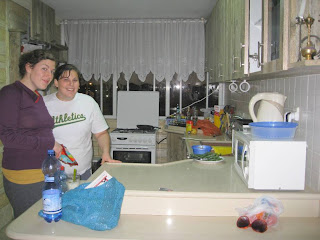 In the kitchen
 Sara Beckerman, volunteer from Phoenix
 Zara from Seattle
 Adam from Phoenix next to Salomon, a new member of the Kiryat Malachi Steering Committee
 Justine Slovin from Phoenix
 in the volunteer apt living room
 In the kitchen
 Sara Beckerman, volunteer from Phoenix
 Zara from Seattle
 Adam from Phoenix next to Salomon, a new member of the Kiryat Malachi Steering Committee
Subscribe to:
Posts (Atom)